



Read Next


India’s emerging youth protest movement is attracting growing attention from established opposition parties, raising questions about political cooperation, leadership and the future of independent activism. At the centre of the discussion is student leader Neha Bora, whose appearance alongside Rahul Gandhi and Priyanka Gandhi Vadra during a Congress-led demonstration in Delhi has become a talking point in opposition politics.
The development comes as the Cockroach Janta Party (CJP), a youth-led political movement associated with activist Abhijeet Dipke, continues its campaign against alleged irregularities in India’s electoral system.
While the Congress leadership and CJP have expressed concerns over aspects of the election process, the possibility of closer political cooperation has prompted debate about whether a national party could overshadow an emerging grassroots movement.
Why Neha Bora’s Participation Matters
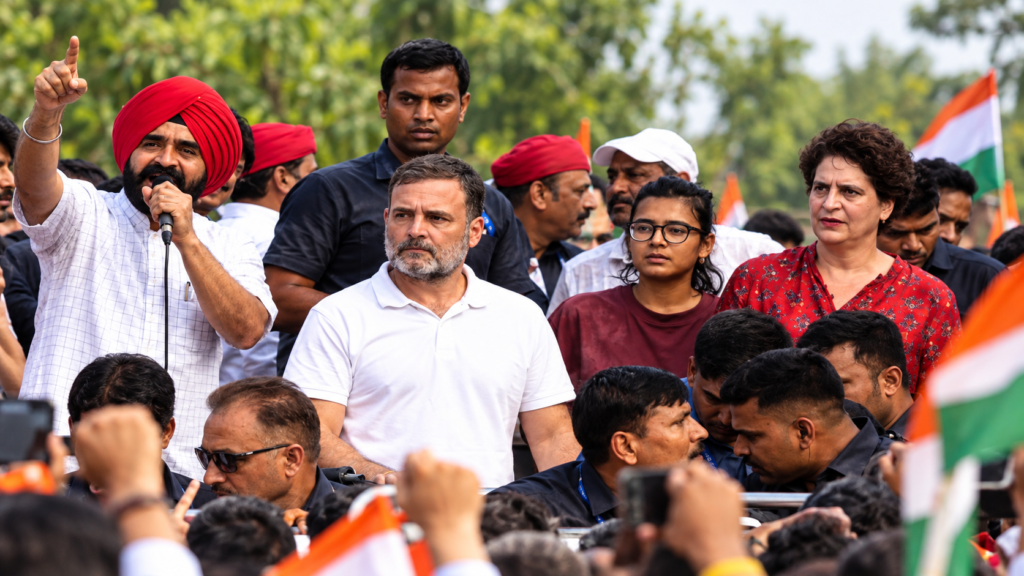
On October 12, Neha Bora, president of the All India Students’ Association (AISA), joined a Congress-led demonstration in New Delhi demanding the resignation of Chief Election Commissioner Gyanesh Kumar.
Bora was seen walking prominently alongside Rahul Gandhi and Priyanka Gandhi Vadra as protesters headed towards the Supreme Court.
Her participation drew attention because she represents a left-wing student organisation rather than the Congress-affiliated National Students’ Union of India (NSUI).
Bora has developed a public profile through student activism and demonstrations concerning educational accountability, electoral transparency and civil rights.
Her presence at the Congress march therefore provided an example of cooperation among opposition figures and organisations with different political backgrounds.
Whether that cooperation will develop into a lasting alliance remains uncertain.
CJP’s Rise Has Changed the Youth Protest Landscape
The Cockroach Janta Party has emerged as a distinctive participant in India’s recent wave of student and youth demonstrations.
Led by Abhijeet Dipke, the movement has drawn attention through street protests, social media campaigns and demonstrations challenging government policies.
Concerns over examination irregularities and electoral roll revisions have been among the issues driving participation in the movement.
Unlike established political parties, CJP has relied heavily on its activist identity and its ability to mobilise supporters around specific public grievances.
That independence has helped distinguish the group from conventional opposition politics.
However, increasing cooperation between prominent activists and national political leaders could influence how the movement is perceived by supporters.
Is Congress Expanding Its Influence Among Young Activists?
Rahul Gandhi has repeatedly raised concerns about electoral accountability, democratic institutions and political representation.
These issues overlap with several demands advanced by student organisations and groups participating in the CJP-led protests.
For Congress, closer engagement with emerging activists could provide an opportunity to connect with politically active young people beyond its traditional organisational network.
For youth organisations, cooperation with a national opposition party could potentially bring greater visibility and institutional support.
The central question is whether these relationships will strengthen the broader campaign while preserving the independence of participating groups.
There is currently no conclusive evidence that Rahul Gandhi is attempting to assume control of CJP or replace its leadership.
Detentions Add Pressure to the Protest Movement
Political tensions in Delhi have intensified following a series of demonstrations against Chief Election Commissioner Gyanesh Kumar and the ongoing electoral roll revision exercise.
Authorities increased security in several parts of the capital during October as protesters organised gatherings and marches.
On October 16, police detained CJP founder Abhijeet Dipke and AISA president Neha Bora ahead of a planned demonstration at Connaught Place.
Bora was subsequently released from preventive detention.
Two other CJP figures, Ashutosh Ranka and Saurav Das, have faced continued judicial custody in connection with events surrounding the protests.
The police actions have become another point of disagreement between authorities and opposition activists.
Protest organisers argue that restrictions and detentions undermine the right to peaceful demonstration. Police, meanwhile, have maintained that their interventions were necessary to preserve public order and enforce restrictions around protest locations.
Despite the disruptions, the movement has continued to attract attention in Delhi and other Indian cities.
Electoral Roll Controversy Remains Central
The immediate political dispute concerns the Election Commission of India’s Special Intensive Revision (SIR) of electoral rolls.
Opposition parties and protest groups have questioned whether the exercise could result in eligible voters being excluded from electoral registers.
CJP activists and allied student organisations have demanded greater accountability and called for the resignation of Chief Election Commissioner Gyanesh Kumar.
The Election Commission has rejected allegations of wrongdoing and maintained that the revision process is intended to improve the accuracy of electoral records.
Officials have also pointed to available procedures through which eligible citizens can seek inclusion or correction of their details.
The controversy has therefore developed into a broader debate over electoral administration, public confidence and democratic safeguards.
Could the New Political Alignment Affect Congress’s Student Wing?
The attention surrounding Neha Bora has also raised questions about relationships within opposition student politics.
AISA and NSUI operate within different ideological and organisational traditions.
Bora’s prominent role alongside senior Congress leaders has reportedly generated discussion among sections of the party’s student network about the prominence given to leaders from outside the organisation.
Some may regard broader cooperation as necessary to build an effective opposition platform. Others may be concerned about the political space available to their own student representatives.
Such differences are not unusual when political parties seek to cooperate with independent or ideologically distinct movements.
However, a single joint demonstration does not establish that Bora intends to join Congress or that AISA and CJP are relinquishing their autonomy.
What Lies Ahead for CJP and the Wider Opposition?
The coming weeks could be important for India’s youth-led protest movement.
CJP faces the challenge of maintaining organisational momentum while prominent members deal with police proceedings and restrictions on demonstrations.
Congress, meanwhile, has an opportunity to establish stronger relationships with activists whose campaigns address similar political issues.
Neha Bora’s participation in the October 12 demonstration has brought these overlapping political interests into sharper focus.
But the long-term implications remain unclear.
The movement could develop into a broader alliance of opposition parties, student organisations and independent activists. Alternatively, disagreements over strategy, leadership and political identity could limit cooperation.
For now, the central issue is not whether Rahul Gandhi has taken control of CJP, but whether established political parties and emerging youth movements can work together without compromising their separate identities.

Trending Now
You May Also Like
Leave a Reply
Your email address will not be published. Required fields are marked *


Sharp daily reads on culture, style, wellness, travel, and the stories shaping modern life.
Recent Posts
Popular Posts