



Read Next

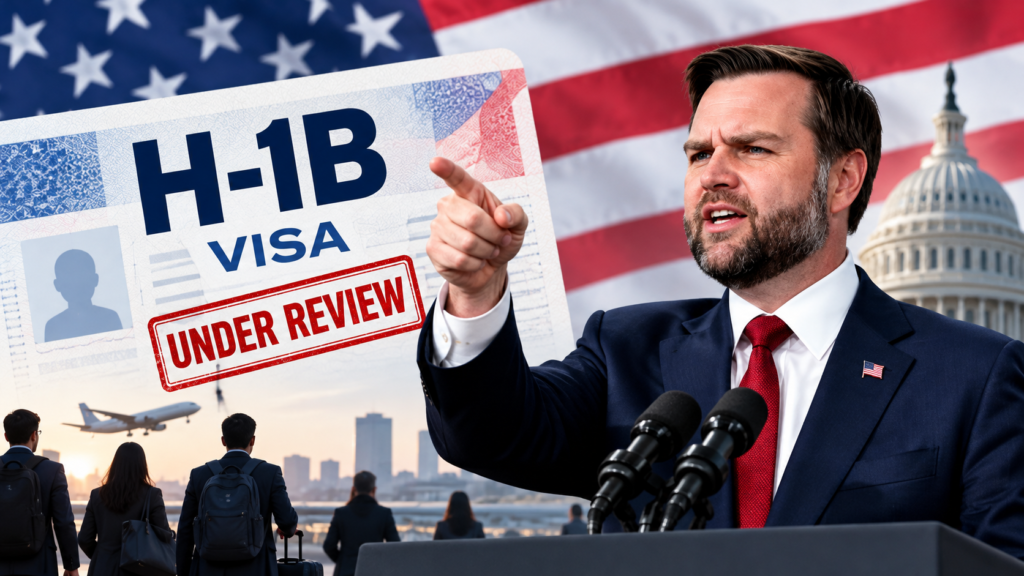
The future of America’s H-1B visa program has returned to the political spotlight after US Vice President JD Vance expressed support for eliminating the employment-based visa category altogether. His remarks have intensified uncertainty among foreign professionals, particularly Indian technology workers and international students planning careers in the United States.
The H-1B program has long provided American employers with a legal pathway to recruit qualified foreign professionals for specialised positions. Indian nationals account for a substantial proportion of its beneficiaries, making any potential changes particularly significant for India’s technology industry.
However, despite the strong political rhetoric, the United States has not announced the complete termination of the H-1B program.
Vance Questions the Purpose of Skilled Worker Visas
Speaking in an interview published in early October, Vance criticised the way American companies have used the H-1B framework.
He argued that a system originally intended to attract exceptional international talent has increasingly become a mechanism for lowering labour expenses.
According to the vice president, certain businesses are hiring foreign employees at lower salaries instead of retaining or recruiting American workers.
He illustrated his criticism with the example of an American accountant earning $60,000 annually being replaced by a foreign worker willing to accept $45,000 for a comparable position.
Vance argued that such recruitment practices undermine the purpose of skilled immigration and place American workers at an unfair disadvantage.
He described the existing H-1B system as fundamentally flawed and indicated that he would support its elimination.
Nevertheless, his comments represented a policy position rather than an immediate administrative order.
Has the United States Officially Cancelled H-1B Visas?
The short answer is no.
As of October 20, 2026, the H-1B visa category has not been abolished. Eligible employers can still pursue petitions under the applicable immigration rules.
The distinction is important because political support for eliminating a visa program does not itself change federal immigration law.
Any attempt to dismantle the existing framework would face legal and administrative questions, including the extent of authority available to the executive branch.
For now, professionals should distinguish between proposals being debated in Washington and rules that have actually taken effect.
The $100,000 Fee Dispute Adds Another Layer of Uncertainty
The debate comes amid continuing legal challenges to the Trump administration’s attempt to impose an additional $100,000 charge on certain H-1B petitions.
The controversial measure was designed to discourage companies from using overseas recruitment as a low-cost alternative to American workers.
The administration maintained that the financial requirement would push employers towards domestic recruitment and discourage misuse of the skilled worker visa system.
However, the policy faced objections from businesses, educational institutions and organisations representing affected workers.
In June 2026, a federal court ruled against the additional fee. Subsequent litigation continued to challenge the administration’s authority to impose the payment.
A separate federal court in California also blocked enforcement of the charge at the end of September.
As a result, the disputed $100,000 fee remains blocked under the relevant court orders. The litigation and broader policy debate are continuing.
Why Indian Technology Companies Are Watching Closely
For India’s technology sector, the H-1B program represents much more than an immigration category.
It has supported cross-border employment, international project delivery and the movement of skilled professionals between India and the United States.
Companies such as Tata Consultancy Services, Infosys and Wipro operate within a global services industry where access to specialised talent is commercially important.
American technology companies also employ significant numbers of foreign-born engineers, developers and researchers.
Stricter visa requirements could increase recruitment costs, complicate workforce planning and make it more difficult to transfer employees to US operations.
The impact would not necessarily be uniform across companies. Businesses with established American workforces, local hiring strategies and operations outside the United States may have more flexibility than organisations heavily dependent on sponsored foreign workers.
Nevertheless, further restrictions could reshape how the technology industry manages international recruitment.
Indian Students Could Face Tougher Career Decisions
The implications extend beyond currently employed professionals.
For many Indian students pursuing university degrees in the United States, access to employment after graduation is an important consideration when choosing where to study.
Eligible international graduates may obtain temporary work authorisation through Optional Practical Training, commonly known as OPT.
Some subsequently seek employer sponsorship under the H-1B program to continue working in specialised occupations.
If the visa category were eliminated or substantially restricted, this transition could become more difficult.
However, a possible change to H-1B rules does not automatically mean that student visas, OPT authorisation or all existing immigration benefits would disappear.
Those are separate aspects of the US immigration system, subject to their own legal requirements.
Technology Industry Pushes Back Against Immigration Restrictions
The White House’s approach has also exposed disagreements over how best to protect American jobs.
Supporters of tighter immigration controls argue that employers should prioritise domestic workers and offer competitive wages before recruiting from overseas.
They believe restrictions could help prevent companies from using immigration sponsorship to weaken salary growth or replace local employees.
Technology executives have offered a different perspective.
Microsoft President Brad Smith has warned that restrictions on skilled immigration and access to permanent residency could harm the United States’ ability to attract and retain highly qualified professionals.
Industry representatives argue that international recruitment contributes to innovation, research and technological leadership, particularly in areas such as artificial intelligence.
The disagreement reflects a broader policy challenge: protecting domestic employment opportunities while maintaining access to the global expertise required by advanced industries.
What Should Existing H-1B Holders Do?
For Indian professionals already working in the United States, the immediate priority is to understand the rules that currently apply to their individual immigration status.
A statement supporting the removal of the H-1B program does not automatically revoke previously approved visas or employment authorisations.
However, workers considering job changes, extensions, international travel or permanent residency applications should pay close attention to official policy developments.
Employers and immigration advisers may also need to reassess future sponsorship plans if new regulations are introduced.
Prospective applicants should rely on current guidance from US Citizenship and Immigration Services and the US Department of State rather than assuming that political proposals are already enforceable.
What Happens Next?
JD Vance’s comments have strengthened the debate over the future of employment-based immigration in the United States.
The administration continues to emphasise the protection of American jobs, while employers and universities have highlighted the economic importance of attracting skilled people from around the world.
The courts, meanwhile, remain an important check on attempts to introduce substantial immigration-related charges without satisfying the required legal procedures.
For Indian workers and students, the coming months may bring further policy announcements, legal developments and possible legislative proposals.
The H-1B program remains operational, but its long-term direction is increasingly uncertain.
Whether Washington ultimately chooses comprehensive reform, more restrictive eligibility requirements or a proposal to eliminate the program will be a major question for American businesses and the international professionals who rely on them.

Trending Now
You May Also Like
Leave a Reply
Your email address will not be published. Required fields are marked *


Sharp daily reads on culture, style, wellness, travel, and the stories shaping modern life.
Recent Posts
Popular Posts